Back to Agriculture
Global Aeroponics Market – Innovating Agriculture Through High-Efficiency Farming Systems
Published Date : December 2, 2025 Category: Agriculture

Published Date : December 2, 2025 Category: Agriculture
Innovating Agriculture Through Vertical, Sustainable, and High-Efficiency Farming Systems
Market Overview
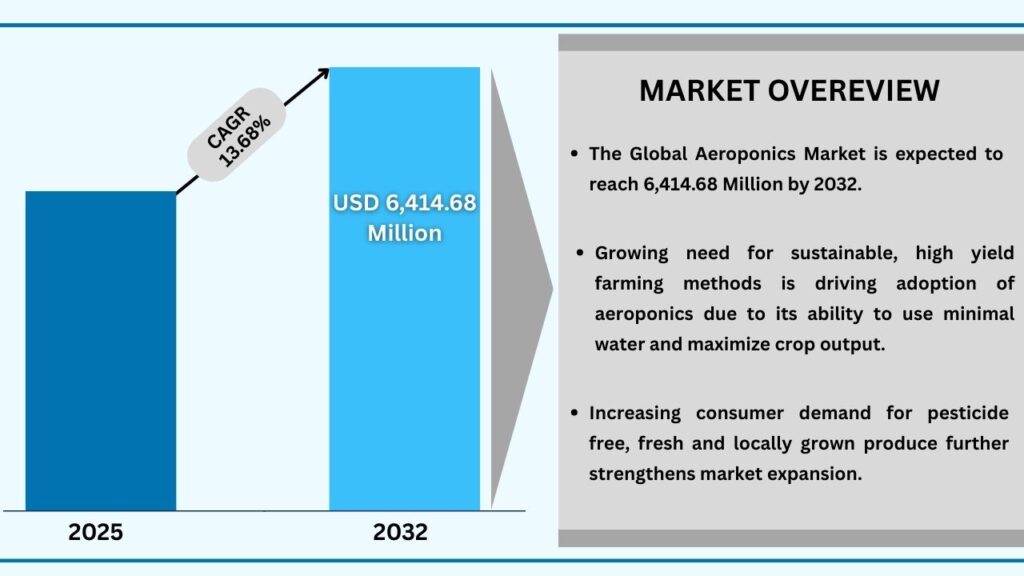
The Global Aeroponics Market is witnessing rapid growth as urbanization, land scarcity, and the need for sustainable food production drive adoption of soil-free, water-efficient farming technologies. Aeroponics, a subset of controlled-environment agriculture, allows crops to grow with nutrient-rich mist delivered directly to plant roots, enabling higher yields, faster growth cycles, and minimal water usage. Increasing consumer demand for fresh, pesticide-free produce and the rising popularity of vertical farming in urban centers are transforming aeroponics from experimental systems into scalable commercial solutions.
Innovations in automation, IoT-enabled sensors, and AI-driven environmental controls are improving operational efficiency, resource utilization, and crop monitoring. Governments and private investors are funding urban and precision agriculture projects to address food security challenges, further boosting aeroponics adoption.
Global Aeroponics Overview
Market Definition
The Aeroponics Market encompasses advanced vertical-farming platforms, modular indoor farms, automated misting systems, sensors, and nutrient-delivery frameworks designed for soil-less plant cultivation. Aeroponics combines air, mist, and nutrient solutions to optimize plant growth, reduce water consumption, and enable year-round crop production.
Key applications include:
The market integrates hydroponic knowledge, IoT-based environmental monitoring, robotics, and precision nutrient management to deliver highly controlled, resource-efficient farming solutions.
Technological Advancements & Innovation Trends
Recent advancements in aeroponics are driving improved yields, lower operational costs, and enhanced scalability. Key innovations include:
These innovations enable high-density vertical growth, faster crop cycles, and significant reductions in water and nutrient wastage.
Market Drivers
The global Aeroponics Market is propelled by:
Market Restraints
Key factors limiting market growth include:
Regional Analysis
Asia-Pacific:
The Asia-Pacific region is emerging as one of the fastest-growing markets for aeroponics, driven by rapid population growth, increasing urbanization, and rising awareness of sustainable agriculture practices. Governments across countries like China, Japan, and India are actively supporting smart agriculture initiatives, providing funding, incentives, and infrastructure development for vertical and indoor farming projects. The region’s focus on addressing food security challenges, reducing dependence on traditional agriculture, and promoting innovative, water-efficient farming methods is accelerating the adoption of aeroponic technologies in both commercial and urban-agriculture settings.
North America:
North America is at the forefront of aeroponics adoption, particularly for commercial and research purposes, due to high consumer demand for organic, fresh, and locally grown produce. The region benefits from strong investment in ag-tech innovation, including automated farming systems, IoT-based monitoring, and precision nutrient delivery, which enhance the efficiency and scalability of aeroponic operations. Additionally, increasing interest from urban developers, food-tech startups, and educational institutions is driving the deployment of indoor and vertical farms, positioning North America as a key hub for advanced aeroponics solutions and sustainable food production technologies.
Europe:
Europe’s aeroponics market is shaped by the region’s emphasis on sustainable agriculture, climate-smart farming, and resource-efficient food production. Countries such as Germany, the UK, and the Netherlands are leading initiatives to implement high-tech indoor farms and modular aeroponics systems, often supported by government grants, innovation programs, and university–industry collaborations. European growers are increasingly adopting controlled-environment agriculture to reduce water consumption, minimize pesticide use, and optimize crop yields, aligning with broader environmental goals and consumer demand for safe, high-quality produce. This focus on technological integration and sustainability is driving steady growth across the region’s aeroponics sector.
Competitive Landscape
The Aeroponics Market is moderately fragmented, with companies competing based on technological innovation, system scalability, crop yield efficiency, and turnkey solutions. Key players include:
Companies are increasingly focusing on automated nutrient delivery, AI-powered monitoring, modular farm units, and strategic collaborations with urban developers and retail chains.
Strategic Developments
Expansion of Modular Urban Farms (2025):
Leading aeroponics companies are deploying containerized, modular farms in urban centers to meet the rising demand for fresh produce. These systems enhance scalability, energy efficiency, and year-round crop production.
AI-Driven Farming Solutions (2025):
Firms are integrating AI and IoT sensors to optimize environmental conditions, nutrient supply, and crop monitoring, significantly reducing operational costs and improving productivity.
Future Market Outlook & Emerging Opportunities
The global Aeroponics Market is poised for significant growth as the demand for sustainable and space-efficient farming solutions continues to rise. Urban agriculture and vertical-farming technologies are gaining traction worldwide, offering opportunities for expansion into rooftop farms, indoor urban farms, and modular farming units that can be deployed in densely populated areas. Companies are increasingly exploring collaborations with smart-city projects and food-tech startups to integrate advanced aeroponics systems into urban infrastructure, creating localized, fresh, and pesticide-free food sources. Additionally, hybrid farming systems that combine hydroponics and aeroponics are emerging, providing enhanced crop yield, faster growth cycles, and improved resource efficiency.
Beyond conventional crops, aeroponics is finding applications in high-value medicinal plants, specialty herbs, and niche horticultural products, opening new revenue streams for growers. Long-term market growth will be driven by the global need for water-efficient farming, climate-resilient agriculture, and sustainable food production practices. As consumers continue to prioritize fresh, safe, and eco-friendly produce, and governments invest in precision agriculture and smart-farming initiatives, aeroponics is set to become a critical component of the future agricultural landscape.
Conclusion
The Global Aeroponics Market is evolving rapidly, driven by technological innovation, urbanization, and sustainability imperatives. With AI, IoT, and modular vertical-farming solutions, aeroponics is transforming modern agriculture, offering higher yields, lower resource consumption, and year-round production. As industries and governments invest in precision agriculture and smart-farming solutions, aeroponics is poised to play a pivotal role in the future of sustainable food systems.
At Advantia Business Consulting, we help ag-tech leaders, investors, and urban-farming operators convert aeroponics innovation into profitable, scalable businesses. Our advisory services — market intelligence, go-to-market strategy, partner & funding sourcing, and scale-up risk mitigation — are tailored to accelerate commercialization, optimise operations, and maximise returns across vertical farms, modular urban deployments, and high-value crop projects. Reach out to Advantia Business Consulting for a customised roadmap that turns your aeroponics capability into a competitive, sustainable advantage.