Back to Agriculture
Global Aquaculture Fertilizer Market
Published Date : December 5, 2025 Category: Agriculture

Published Date : December 5, 2025 Category: Agriculture
Enhancing Aquatic Productivity Through Nutrient Optimization, Sustainable Inputs, and High-Efficiency Farming Systems
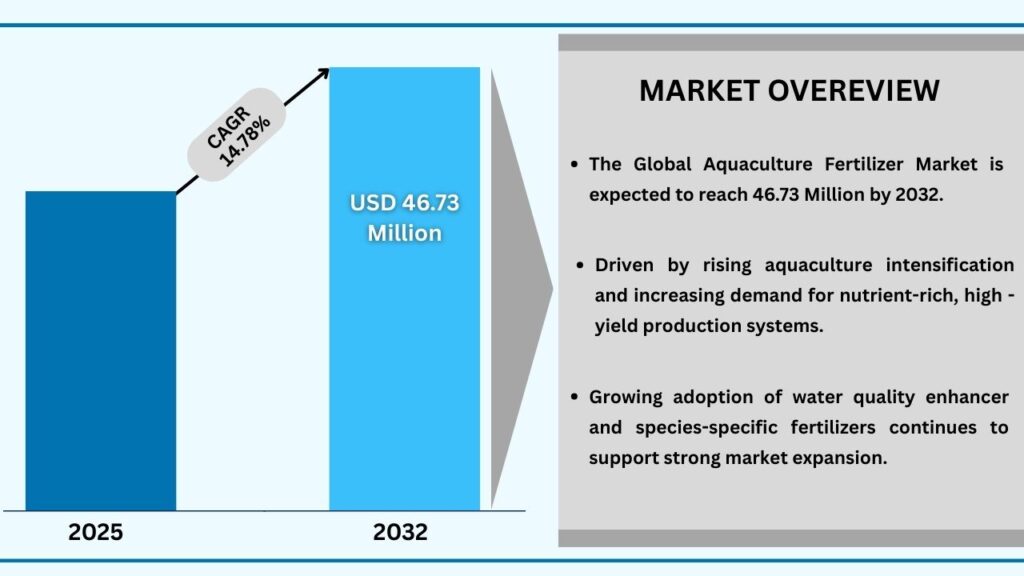
Market Overview
The Global Aquaculture Fertilizer Market is experiencing strong and sustained growth as rising seafood demand, expanding commercial aquaculture operations, and the need for efficient pond management drive the adoption of specialized nutrient solutions. Aquaculture fertilizers play a vital role in promoting phytoplankton development, improving water quality, and supporting stable growth conditions for fish and shrimp. With more producers shifting from traditional extensive methods to semi-intensive and intensive farming systems, the importance of consistent nutrient application and controlled pond ecosystems has increased significantly.
Growing focus on sustainable aquaculture practices, combined with advances in nutrient formulations, microbial fertilizers, and water-soluble blends, is further propelling market expansion. The integration of automated dosing systems, real-time water-quality monitoring, and data-driven farm management tools is improving fertilizer efficiency and production outcomes. Governments and private stakeholders are increasingly investing in modern aquaculture hubs, export-oriented farming clusters, and environmentally safe input solutions, strengthening the global demand for high-performance aquaculture fertilizers.
Global Aquaculture Fertilizer Market
Market Definition
The Aquaculture Fertilizer Market includes specialized chemical, organic, and microbial fertilizers designed for pond, tank, and recirculating aquaculture systems. These fertilizers provide essential nutrients—such as nitrogen, phosphorus, and potassium—to optimize plankton growth, improve water quality, and support high-density fish and shrimp production.
Key Applications Include:
Intensive and Semi-Intensive Shrimp and Fish Farms:
Fertilizers stimulate plankton growth and improve water quality, supporting healthier aquatic environments. They enhance feed utilization and promote faster growth cycles. This enables higher stocking densities and more efficient production. Overall, they help maximize yield and profitability in commercial farms.
Biofloc and Recirculating Aquaculture Systems (RAS):
Precise nutrient management sustains beneficial microbial communities critical for system health. Fertilizers help balance water chemistry and maintain optimal dissolved oxygen and ammonia levels. They improve feed efficiency and reduce waste accumulation. This ensures a stable and productive aquaculture environment.
Hatcheries and Research Institutions:
Fertilizers support early-stage growth of larvae and juvenile fish or shrimp. They provide essential nutrients for uniform development and high survival rates. Research institutions use them to test species-specific nutrient needs. This enables controlled studies and improves overall hatchery performance.
Export-Oriented and High-Value Species Production:
Controlled fertilizer application ensures consistent growth and product quality. It helps maintain water quality and nutrient balance for sensitive species. Fertilizers support compliance with international safety and export standards. This is critical for producing premium, high-value seafood.The market integrates nutrient optimization, water-quality monitoring, automated dosing, and precision aquaculture techniques to deliver resource-efficient and sustainable aquatic farming solutions.
Technological Advancements & Innovation Trends
Recent innovations are driving higher yields, reduced input costs, and enhanced scalability. Key trends include:
These advancements enable faster growth cycles, improved feed conversion, and efficient nutrient utilization while minimizing environmental impact.
Market Drivers
The global Aquaculture Fertilizer Market is propelled by:
Market Restraints
Growth is restrained by:
Regional Analysis
Asia-Pacific:
Asia-Pacific dominates the Aquaculture Fertilizer Market due to its expansive aquaculture production base, high seafood consumption, and strong government support for modern farming practices. Countries such as China, India, Vietnam, and Thailand are heavily investing in sustainable pond management, biofloc systems, and intensive shrimp and fish farming. These initiatives, coupled with growing domestic and export demand for seafood, are driving widespread adoption of fertilizers to optimize pond productivity, enhance growth rates, and improve feed conversion efficiency across the region.
North America:
North America represents a key market for aquaculture fertilizers, driven by the adoption of precision aquaculture techniques and nutrient optimization solutions. Commercial farms, hatcheries, and research institutions are deploying advanced water-quality monitoring technologies, automated dosing systems, and data-driven nutrient management practices. Strong demand for high-quality, export-grade seafood, along with investments in commercial aquaculture hubs, is supporting consistent growth and encouraging the use of fertilizers to enhance yield, maintain pond health, and ensure sustainable operations.
Europe:
Europe emphasizes sustainable and eco-friendly aquaculture practices, with countries such as Norway, Spain, and the Netherlands leading in the implementation of advanced nutrient management and controlled-environment aquaculture systems. Regulatory frameworks focused on environmental safety, export compliance, and resource-efficient production encourage the adoption of high-performance fertilizers. European farms are increasingly integrating technological innovations, including automated nutrient delivery and water-quality monitoring, to optimize pond productivity, reduce chemical usage, and meet growing consumer demand for safe, high-quality seafood products.
Competitive Landscape
The Aquaculture Fertilizer Market is moderately fragmented, with companies competing on product innovation, nutrient efficiency, water-quality management, and turnkey solutions. Key players include:
Companies are focusing on automated dosing systems, AI-driven monitoring, specialized species-specific formulations, and strategic collaborations with commercial farms and hatcheries.
Strategic Development
Expansion of Intensive Aquaculture Facilities (2025):
Leading fertilizer providers are deploying solutions tailored to high-density shrimp and fish farms, enhancing pond productivity, nutrient utilization, and scalability.
AI-Enabled Nutrient Management (2025):
Firms are integrating AI and IoT tools to monitor water quality, optimize nutrient dosing, and improve growth performance, reducing operational costs and increasing yield.
Future Market Outlook & Emerging Opportunities
The global Aquaculture Fertilizer Market is poised for significant growth as demand for high-yield, sustainable, and resource-efficient aquaculture rises. Opportunities include expansion into biofloc and RAS systems, hatcheries, and high-value species production, as well as collaboration with smart aquaculture projects, research institutions, and export-oriented farms.
Emerging trends such as organic and microbial fertilizers, water-soluble nutrient blends, and AI-driven pond management are creating new revenue streams and improving sustainability. Long-term growth will be driven by global seafood demand, technological integration, and regulatory support for environmentally safe aquaculture practices.
The Conclusion
Aquaculture Fertilizer Market is evolving rapidly, driven by technological innovation, aquaculture intensification, and sustainability imperatives. With AI, IoT, automated dosing, and specialized nutrient formulations, fertilizers are transforming aquaculture operations—offering higher yields, improved feed efficiency, and reduced environmental impact. As governments and industries continue to invest in precision aquaculture, the market is poised to become a cornerstone of sustainable seafood production worldwide.
At Advantia Business Consulting, we help aquaculture producers, input manufacturers, and investors translate market insights into executable growth plans. From species-specific product strategy and regulatory pathway support to AI-enabled nutrient management roadmaps and partner/funding sourcing, our advisory services de-risk scale-up and accelerate commercial adoption. Contact Advantia Business Consulting to discuss a tailored strategy that maximises yield, compliance, and ROI for your aquaculture fertilizer initiatives.