Back to Defence
Global Vertiports Market – Enabling the Future of Urban Air Mobility
Published Date : December 8, 2025 Category: Defence
Published Date : December 8, 2025 Category: Defence
Enabling the Future of Urban Air Mobility with Smart, Scalable, and Sustainable Infrastructure
Market Overview
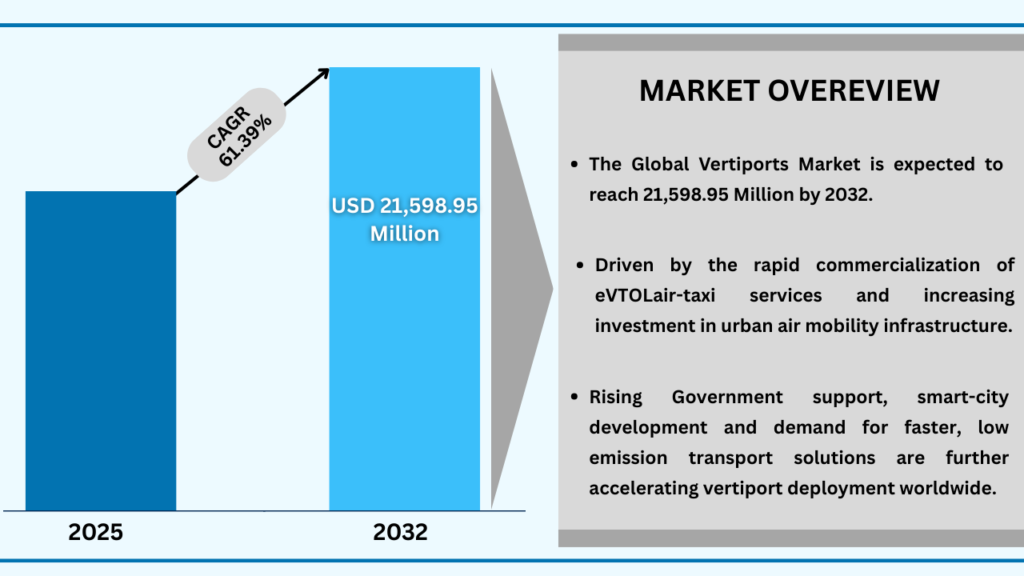
The Global Vertiports Market is experiencing rapid growth as urbanization, traffic congestion, and the need for faster, sustainable transport solutions drive the adoption of eVTOL-based air mobility. Vertiports serve as dedicated takeoff and landing hubs for eVTOL aircraft, integrating passenger handling, charging stations, and ground control operations to ensure efficient and safe urban air travel. Rising interest in zero-emission, point-to-point aerial transport, along with government initiatives supporting smart-city infrastructure, is transforming vertiports from pilot projects into scalable commercial mobility solutions.
Technological innovations in automation, AI-driven traffic management, and IoT-enabled monitoring are improving operational efficiency, fleet management, and safety. Public and private investment in advanced air mobility networks, airport-city integration, and multimodal connectivity is further accelerating vertiports adoption worldwide.
Global Vertiports Overview
Market Definition
The Vertiports Market encompasses ground-based, rooftop, and floating platforms equipped with landing pads, terminal gates, charging systems, and passenger-handling facilities for eVTOL aircraft. Vertiports integrate air-traffic coordination, autonomous ground handling, and safety monitoring systems to provide controlled, high-efficiency urban air mobility operations.
Key Applications Include: “Vertiports: Powering Next-Generation Urban Air Mobility”
Vertiports serve as critical infrastructure for a range of urban air mobility applications. They enable passenger transport services, acting as hubs for air-taxi networks that reduce traffic congestion and provide rapid point-to-point travel within cities. They also support cargo and logistics operations, including last-mile deliveries using eVTOLs and drones, enhancing supply chain efficiency. In addition, vertiports are vital for emergency response and medical evacuation, offering rapid deployment of aerial assets for life-saving operations and public safety. Finally, they facilitate research, development, and pilot projects, allowing governments, private operators, and technology developers to test and refine advanced air mobility solutions, paving the way for scalable and safe commercial deployment.
Vertiports combine aviation infrastructure expertise, automation technologies, and digital airspace management to deliver highly efficient, safe, and scalable urban air mobility solutions.
Technological Advancements & Innovation Trends
Recent advancements in vertiport infrastructure are driving higher operational efficiency, reduced turnaround times, and increased scalability. Key innovations include:
These innovations enable high-frequency operations, safe and efficient passenger handling, and seamless integration with urban mobility systems.
Market Drivers
The global Vertiports Market is propelled by:
Driving the Future of Urban Air Mobility”
The global Vertiports Market is fueled by several key growth drivers. Rapid adoption of eVTOL aircraft and air-taxi services in metropolitan regions is creating high demand for dedicated vertiport infrastructure, enabling faster, congestion-free travel. Government investments in smart-city initiatives, sustainable transportation, and urban air mobility infrastructure are further accelerating development, providing regulatory support, funding, and integration with existing transit systems. Additionally, technological advancements in automation, AI-driven traffic management, and digital airspace control are enhancing operational efficiency, safety, and scalability, making vertiports a cornerstone of next-generation urban mobility solutions.
Market Restraints
Key factors limiting market growth include:
Regional Analysis
North America:
North America leads the global vertiports market due to early adoption of eVTOL operations, supportive regulatory frameworks, and significant investment from both private and public sectors. Key cities are piloting vertiport networks as part of larger urban air mobility initiatives, establishing the region as a hub for innovation and commercialization.
Europe:
Europe emphasizes sustainable and climate-smart urban mobility solutions. Countries such as Germany, France, and the UK are integrating vertiports with existing transport networks and smart-city projects, supported by government grants and public-private partnerships.
Asia-Pacific:
The Asia-Pacific region is emerging as a fast-growing market, with governments in China, Japan, and India actively supporting urban air mobility development. Rapid urbanization, investment in smart infrastructure, and a focus on reducing traffic congestion are driving strong adoption of vertiports.
Latin America & Middle East & Africa:
Emerging regions are witnessing gradual adoption of vertiports, driven by urban development projects, government initiatives, and pilot air mobility programs. These markets offer growth potential as cities explore innovative solutions for traffic decongestion and sustainable transportation.
Competitive Landscape
The Vertiports Market is moderately fragmented, with companies competing based on infrastructure innovation, scalability, safety compliance, and integration with eVTOL ecosystems. Key players include:
Skyports Infrastructure, Urban-Air Port, Volocopter (VoloPort), Lilium, EHang, Archer Aviation, Joby Aviation, Ferrovial Vertiports, Groupe ADP, Skyway
Leading participants focus on automated ground handling, AI-based fleet management, rapid-deploy modular vertiports, and strategic collaborations with municipalities, airport authorities, and eVTOL manufacturers. Emerging companies offer cost-efficient, flexible solutions tailored to urban, suburban, and remote deployments, creating a dynamic, innovation-driven ecosystem.
Strategic Developments
Expansion of Modular Vertiports (2024–2025):
Companies are deploying modular, rapidly deployable vertiports in urban centers to support passenger transport, cargo logistics, and emergency services. These units enhance scalability, operational efficiency, and rapid network expansion.
AI-Driven Airspace & Operations Management (2024–2025):
Leading firms are integrating AI and IoT-based solutions to optimize flight scheduling, airspace utilization, passenger handling, and predictive maintenance, reducing operational costs while improving safety and reliability.
Future Market Outlook & Emerging Opportunities
The global Vertiports Market is poised for substantial growth as cities adopt smart mobility solutions and eVTOL networks expand worldwide. Opportunities exist in:
Increasing investment, regulatory clarity, and technological innovation are expected to drive long-term adoption, making vertiports a critical component of sustainable, high-efficiency urban air mobility ecosystems.
Conclusion
The Global Vertiports Market is evolving rapidly, fueled by urbanization, sustainability imperatives, and the rise of eVTOL aircraft. With modular designs, AI-driven traffic management, and integrated infrastructure, vertiports are set to transform urban transportation, enabling faster, safer, and more efficient air mobility. As governments, private players, and smart-city projects invest in air mobility networks, vertiports will play a pivotal role in shaping the future of urban transport globally.
At Advantia Business Consulting, we partner with urban planners, transport operators, and aerospace innovators to turn vertiport concepts into deployable, revenue-generating networks. Our advisory services—market & site feasibility, regulatory roadmap development, stakeholder engagement, commercial modelling, and scale-up planning—help clients de-risk implementation and accelerate integration with existing multimodal systems. Contact Advantia Business Consulting to design a tailored vertiport strategy that balances safety, scalability, and commercial viability for your urban air mobility initiatives.