Back to Information and Technology
Global Vector Database Market
Published Date : December 16, 2025 Category: Information and Technology
Published Date : December 16, 2025 Category: Information and Technology
The Global Vector Database Market is experiencing rapid acceleration as enterprises increasingly adopt artificial intelligence (AI), machine learning (ML), and large language models (LLMs) across mission-critical applications. As organizations shift toward data-intensive, real-time, and context-aware systems, traditional relational and NoSQL databases are proving insufficient for managing high-dimensional, unstructured data. Vector databases have emerged as a foundational technology enabling semantic search, recommendation engines, generative AI, computer vision, and natural language understanding.
With the exponential growth of embeddings generated from text, images, audio, and video, businesses are prioritizing scalable vector storage, high-performance similarity search, and low-latency retrieval. From AI-powered search engines and conversational assistants to fraud detection, personalization, and autonomous systems, vector databases are transitioning from experimental deployments to enterprise-wide infrastructure components.
Market Overview
The Vector Database market is expanding at a strong pace as organizations modernize their data architectures to support AI-native workloads. Unlike traditional databases, vector databases are purpose-built to store and index vector embeddings and enable fast approximate nearest neighbor (ANN) searches across massive datasets.
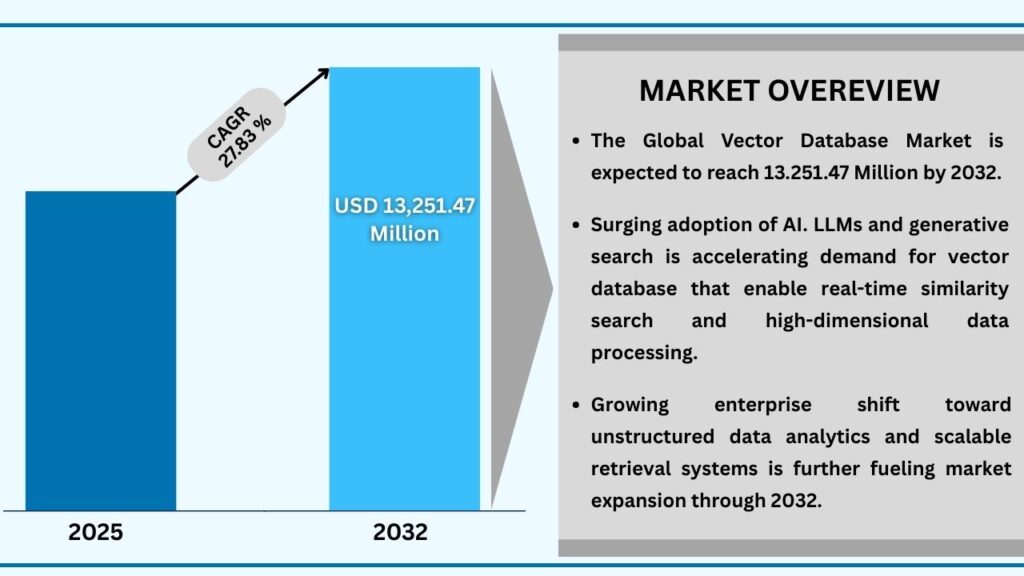
This growth is fueled by rising adoption of generative AI, retrieval-augmented generation (RAG), real-time analytics, and multimodal AI applications. Enterprises across BFSI, retail, healthcare, media, manufacturing, and IT services are deploying vector databases to improve search relevance, automate decision-making, enhance customer experiences, and unlock deeper insights from unstructured data.
Cloud-native deployments, API-first architectures, and open-source innovation are further accelerating commercialization and mainstream adoption.
Market Overview- Global Vector Database Market
Market Definition
The Vector Database Market comprises software platforms, cloud services, and supporting tools designed to store, manage, index, and retrieve vector embeddings generated by AI and ML models. These systems enable similarity search and semantic understanding at scale.
Key components include:
• Vector storage and indexing engines
• Approximate nearest neighbor (ANN) algorithms (e.g., HNSW, IVF, PQ, graph-based indexing)
• Embedding management and lifecycle tools
• Real-time vector search and query processing
• Metadata filtering and hybrid search (vector + keyword)
• Cloud-managed, on-premises, and hybrid deployment models
Vector databases serve as the backbone for modern AI pipelines, enabling fast, accurate, and context-aware data retrieval.
Technological Advancements & Evolution of Vector Data Management
Rapid innovation in AI infrastructure and data engineering is reshaping the vector database landscape. Vendors are enhancing scalability, query performance, and integration capabilities to meet production-grade enterprise requirements.
Key technological developments include:
• Advanced ANN indexing techniques for billion-scale vectors
• Low-latency, real-time vector search optimized for AI inference
• Hybrid search engines combining vector similarity with structured filters
• Native integration with LLMs, foundation models, and AI frameworks
• GPU-accelerated vector processing for high-throughput workloads
• Distributed architectures supporting multi-region and multi-cloud deployments
• Built-in monitoring, governance, and observability tools
These advancements are enabling vector databases to support complex AI workflows across diverse environments.
Market Limitations, Challenges & Barriers
Despite strong momentum, the Vector Database market faces several challenges:
• High infrastructure and compute costs for large-scale deployments
• Complexity in managing embeddings and model versioning
• Performance trade-offs between accuracy, speed, and memory usage
• Limited enterprise familiarity with vector-native data architectures
• Integration challenges with legacy data platforms
• Evolving standards across open-source and commercial ecosystems
Smaller organizations may face adoption hurdles without managed cloud services or turnkey AI platforms.
Policy Landscape, Data Governance & Enterprise Transformation
As AI adoption increases, regulatory and governance considerations are shaping vector database deployment strategies. Enterprises are implementing data privacy controls, access management, auditability, and compliance mechanisms to meet global regulations such as GDPR, HIPAA, and emerging AI governance frameworks.
Government agencies, financial institutions, and healthcare organizations are emphasizing secure, transparent, and explainable AI pipelines—driving demand for vector databases with enterprise-grade security, encryption, and governance features.
Vector databases are increasingly embedded within broader digital transformation and AI modernization initiatives.
Integration of AI, MLOps & Cloud-Native Architectures
Vector databases are deeply integrated into modern AI stacks, working alongside MLOps pipelines, cloud orchestration platforms, and microservices architectures.
AI and automation are being leveraged to:
• Optimize vector indexing and query performance
• Automate embedding refresh and lifecycle management
• Enable adaptive search ranking and relevance tuning
• Monitor data drift and model performance
• Support continuous learning and feedback loops
The convergence of vector databases with cloud-native services, DevOps, and MLOps is enabling scalable, resilient, and production-ready AI systems.
Regional Market Landscape
North America
North America leads the market due to strong adoption of generative AI, cloud computing, and enterprise analytics. The presence of major AI vendors, hyperscalers, startups, and research institutions drives rapid commercialization.
Europe
Europe shows steady growth, supported by enterprise AI adoption, strong data governance frameworks, and increasing investments in AI-driven digital transformation across BFSI, manufacturing, and healthcare.
Asia-Pacific
Asia-Pacific is the fastest-growing region, driven by expanding digital economies, AI-first enterprises, smart infrastructure projects, and rapid cloud adoption across China, India, Japan, South Korea, and Southeast Asia.
Competitive Landscape — Global Vector Database Market
The Vector Database market includes a mix of open-source platforms, cloud-native startups, AI infrastructure providers, and established database vendors. Competition is based on scalability, performance, ease of integration, deployment flexibility, and AI ecosystem compatibility.
Key Market Participants Include:
• Pinecone
• Milvus (Zilliz)
• Weaviate
• Chroma
• Qdrant
• Redis (Vector Search)
• Elasticsearch
• MongoDB
• Oracle
• Amazon Web Services
• Google Cloud
• Microsoft Azure
• DataStax
• Vespa
Companies are investing in advanced indexing algorithms, managed services, AI integrations, and enterprise-grade security features to strengthen market positioning.
Strategic Industry Developments
Enterprise-Scale Vector Search Expansion (2025)
In 2025, a leading cloud provider expanded its managed vector database capabilities, enabling large enterprises to deploy real-time semantic search and RAG pipelines across global cloud regions.
AI Platform & Vector Database Integration (2025)
A major AI platform provider partnered with a vector database vendor to deliver end-to-end generative AI solutions, combining embeddings, vector search, and LLM inference into a unified enterprise offering.
Future Market Outlook & Emerging Directions
The future of the Vector Database Market will be driven by:
• Widespread adoption of generative AI and RAG architectures
• Multimodal vector databases supporting text, image, audio, and video
• Deeper integration with LLMs and autonomous AI agents
• Real-time personalization and recommendation engines
• AI-powered cybersecurity and fraud detection systems
• Open-source innovation and ecosystem standardization
Vector databases will become a core layer of AI-native digital infrastructure.
Conclusion
The Global Vector Database Market is undergoing a significant transformation as enterprises embrace AI-driven decision-making and semantic intelligence. Supported by rapid advancements in AI, cloud computing, and data engineering, vector databases are evolving from niche technologies into foundational enterprise platforms. As organizations scale generative AI, real-time analytics, and intelligent applications, vector databases will play a critical role in enabling performance, accuracy, and competitive advantage across industries.
At Advantia Business Consulting, we help enterprises, AI solution providers, and technology investors translate vector database adoption into measurable business outcomes. Our consulting expertise spans market intelligence, AI data architecture strategy, competitive benchmarking, and go-to-market planning—enabling organizations to deploy vector databases efficiently across generative AI, semantic search, recommendation engines, and real-time analytics. Partner with Advantia Business Consulting to build scalable, future-ready AI data foundations and stay ahead in the rapidly evolving vector database landscape.