Back to Food and Beverages
Global Cold Chain Market
Published Date : February 12, 2026 Category: Food and Beverages
Published Date : February 12, 2026 Category: Food and Beverages
Market Pulse: Global Cold Chain Industry
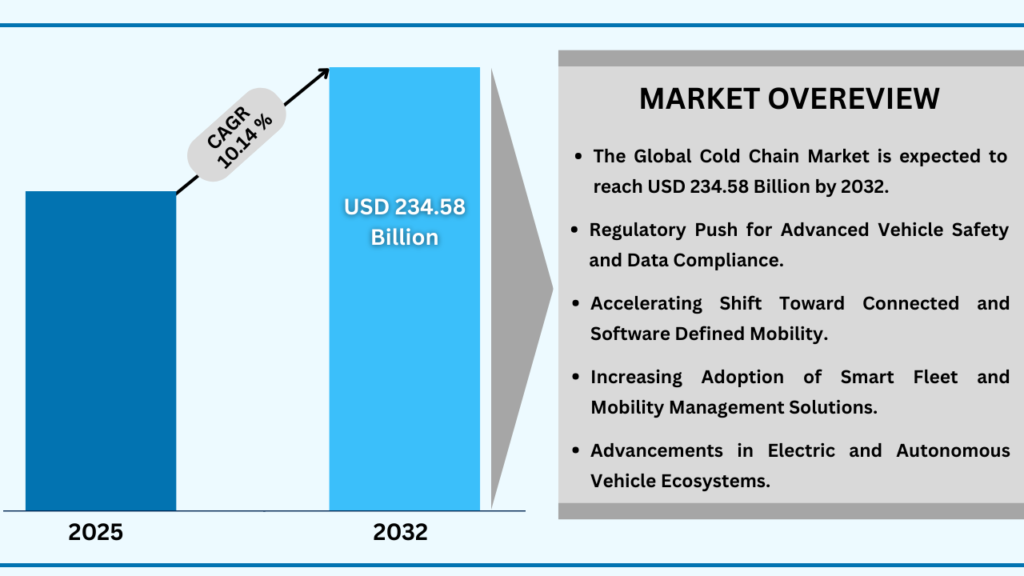
The global cold chain market is witnessing robust growth as temperature-controlled logistics become increasingly critical for food safety, pharmaceutical stability, and biotech supply chains. Rising global trade in perishable goods, expanding vaccine distribution networks, and growing consumer demand for fresh and frozen foods are accelerating investments in cold storage infrastructure and refrigerated transport worldwide.
Cold chain networks are no longer limited to basic refrigeration. Modern systems incorporate IoT sensors, real-time tracking, and automated temperature controls to maintain product integrity across long distances. As globalization of food and pharmaceutical supply chains intensifies, the need for reliable cold chain solutions continues to surge.
Urbanization, e-commerce grocery delivery, and stricter regulatory frameworks around food and drug safety are further strengthening market demand. Emerging markets are also upgrading logistics infrastructure, contributing significantly to global cold chain expansion.
Market Definition
The Global Cold Chain Market refers to the network of temperature-controlled storage, transportation, packaging, and monitoring solutions designed to preserve the quality, safety, and shelf life of perishable products. Cold chain systems maintain specific temperature ranges throughout the supply chain to prevent spoilage and degradation.
These systems enable the controlled handling and movement of products such as food, beverages, pharmaceuticals, biologics, and chemicals. Cold chains utilize refrigerated warehouses, reefer vehicles, insulated packaging, and digital monitoring technologies to track temperature, humidity, and product conditions in real time. Data collected from sensors and tracking systems is transmitted to centralized platforms for monitoring, compliance, and quality assurance.
Industry Scope Explained
The cold chain market encompasses the storage, handling, and transportation of temperature-sensitive products under controlled conditions to preserve quality and safety. It includes refrigerated warehouses, cold rooms, reefer trucks, insulated packaging, and monitoring technologies.
Products commonly moved through cold chains include fresh produce, dairy, seafood, meat, frozen foods, pharmaceuticals, biologics, and specialty chemicals. The ecosystem involves logistics providers, warehouse operators, equipment manufacturers, packaging firms, and technology vendors.
Cold chains typically operate across chilled, frozen, and deep-freeze temperature ranges, depending on product requirements. Maintaining temperature integrity throughout transit and storage is the foundation of this industry.
Core Strengths of Modern Cold Chains
Adaptive Infrastructure Across Industries
Cold chain solutions are highly adaptable across multiple industries, with food retailers, pharmaceutical companies, and chemical manufacturers depending on customized storage and transportation systems designed for specific temperature requirements. Multi-temperature warehouses and hybrid refrigerated transport enable operators to manage a wide range of perishable and temperature-sensitive products at the same time, allowing greater flexibility in logistics planning. This adaptability helps maximize asset utilization, streamline operations, and improve overall supply chain efficiency while maintaining product quality and safety.
Precision Monitoring and Quality Assurance
Technological integration has significantly improved the reliability of cold chain operations by enabling real-time monitoring and greater transparency across the supply chain. Smart sensors, RFID tracking, and cloud-based platforms provide continuous visibility into temperature and humidity conditions, ensuring products remain within required ranges. Automated alert systems quickly notify operators of any deviations, allowing immediate corrective action to prevent spoilage or quality degradation. Such advanced monitoring solutions are especially vital for high-value pharmaceutical shipments, where even minor temperature fluctuations can lead to substantial financial losses and compliance risks.
Operational Optimization and Waste Reduction
Efficient cold chain systems play a crucial role in reducing product spoilage and minimizing waste by maintaining consistent temperature control throughout storage and transportation. Strategies such as optimized routing, energy-efficient refrigeration technologies, and predictive maintenance help lower fuel consumption, reduce equipment downtime, and control overall operational costs. At the same time, improved cold chain management contributes to sustainability objectives by decreasing food loss and cutting carbon emissions through smarter logistics planning and better resource utilization across the supply chain.
Market Barriers and Industry Constraints
Capital-Intensive Infrastructure Requirements
Cold storage facilities and refrigerated vehicles require high upfront investments. Energy consumption, maintenance costs, and specialized equipment add to operational expenses.
In developing regions, limited infrastructure and unreliable power supply create additional hurdles for cold chain expansion.
Energy Dependency and Environmental Concerns
Cold chain operations depend heavily on electricity and refrigerants. Rising energy costs and environmental regulations around refrigerant gases pose challenges for operators.
Transitioning to eco-friendly refrigeration technologies requires significant investment and regulatory compliance efforts.
Regional Dynamics: North America and Asia Driving Demand
North America remains a leading market for cold chain services, supported by advanced food distribution networks, strong pharmaceutical logistics demand, and well-established cold storage infrastructure aligned with strict regulatory standards. In contrast, Asia-Pacific is emerging as the fastest-growing region, driven by increasing food consumption, expanding pharmaceutical manufacturing, and rapid urbanization. Major economies such as China and India are making significant investments in cold chain infrastructure to minimize food loss, strengthen supply chain efficiency, and enhance healthcare logistics capabilities.
Competitive Environment and Key Participants
The cold chain market features a mix of global logistics providers, specialized cold storage operators, and technology firms. Key companies include:
• Lineage Logistics
• Americold Realty Trust
• Nichirei Logistics Group
• Burris Logistics
• United States Cold Storage
• DHL Supply Chain
• Kuehne+Nagel
• DB Schenker
• Maersk Logistics
• VersaCold Logistics
Market participants are increasingly investing in warehouse automation, advanced digital monitoring solutions, and sustainable refrigeration technologies to strengthen their competitive position and improve operational efficiency. Automation helps streamline inventory management and handling processes, while digital monitoring tools provide real-time visibility into temperature and storage conditions. At the same time, the adoption of energy-efficient and environmentally friendly refrigeration systems supports cost savings, regulatory compliance, and corporate sustainability goals, enabling companies to deliver more reliable and responsible cold chain services.
Investment and Partnership Trends
Strategic partnerships between logistics providers and food/pharma companies are becoming more common. Investments are flowing into automated cold warehouses, solar-powered refrigeration, and AI-driven logistics planning.
Private equity interest in cold storage assets is also rising due to stable demand and long-term profitability.
Future Market Direction
The future of the cold chain market will be strongly influenced by ongoing digital transformation, rising sustainability priorities, and growing global demand for high-quality perishable products. Smart warehouses equipped with automation and connected monitoring systems are improving inventory accuracy, reducing manual intervention, and enhancing overall supply chain visibility. In addition, blockchain-enabled traceability is helping ensure product authenticity and regulatory compliance, while AI-driven demand forecasting is allowing operators to better plan capacity, reduce waste, and respond quickly to market fluctuations.
Sustainability will remain a central focus as companies work to lower their environmental footprint. Green refrigeration technologies, including low-GWP refrigerants and energy-efficient cooling systems, are gaining traction across cold storage and transport operations. The integration of renewable energy sources such as solar and wind power into cold chain facilities is also expected to grow, helping reduce carbon emissions and long-term operating costs while supporting global climate goals.
Conclusion
The global cold chain market is steadily transforming into a high-tech logistics ecosystem that plays a critical role in ensuring food security, reliable healthcare delivery, and the smooth flow of global trade. As the movement of temperature-sensitive goods such as fresh foods, vaccines, and biologics continues to expand, the importance of dependable cold chain networks is growing. These systems are becoming essential for maintaining product quality, reducing losses, and strengthening overall supply chain resilience in an increasingly interconnected world.
Companies that proactively invest in advanced technologies, sustainable practices, and scalable infrastructure are likely to gain a competitive advantage in this evolving landscape. Digital tracking, automation, and energy-efficient facilities enable better performance and cost control, while sustainable solutions align with regulatory and consumer expectations. Organizations that balance innovation with reliability and environmental responsibility will be best positioned to capture long-term growth opportunities in the global cold chain market.
At Advantia Business Consulting, we help logistics providers, food and pharmaceutical companies, and investors navigate the complexities of the evolving cold chain ecosystem. Through comprehensive market intelligence, strategic advisory, and technology-focused insights, we support clients in optimizing cold storage investments, adopting digital and sustainable solutions, and strengthening end-to-end temperature-controlled supply chains. Partner with Advantia Business Consulting to build resilient, efficient, and future-ready cold chain strategies in a rapidly expanding global market.