Back to Electronics and Semiconductor
Market Pulse: Global Copper Cable Market Amid Supply Chain and Infrastructure Pressures
Published Date : March 13, 2026 Category: Electronics and Semiconductor
Published Date : March 13, 2026 Category: Electronics and Semiconductor
The Global Copper Cable Market is experiencing steady expansion as rising electrification, telecommunications growth, renewable energy integration, and digital infrastructure development increase the demand for reliable power and data transmission solutions. Copper cables remain the backbone of modern electrical and communication systems due to their superior conductivity, durability, and reliability.
However, the market is also facing significant challenges linked to raw material price volatility, supply chain disruptions, geopolitical tensions affecting copper mining regions, and the growing competition from alternative materials such as aluminum and fiber optic cables.
As global economies accelerate investments in smart grids, data centers, electric vehicles, and renewable energy infrastructure, the demand for copper cables is expected to remain strong. At the same time, fluctuations in copper prices, energy costs, and trade regulations continue to influence production costs, pricing strategies, and long-term supply security across the industry.
Market Definition
The Global Copper Cable Market refers to the manufacturing, distribution, and deployment of copper-based cables used for electrical power transmission, telecommunications, industrial equipment, infrastructure development, and consumer electronics.
Copper cables are widely used across multiple industries due to their high electrical conductivity, corrosion resistance, and mechanical strength.
The market includes several major application areas such as:
• Power transmission and distribution cables
• Building and construction wiring
• Telecommunications and broadband networks
• Industrial machinery and automation systems
• Automotive electrical systems
• Renewable energy infrastructure
• Data centers and digital communication networks
The market ecosystem includes copper wire manufacturers, cable producers, raw material suppliers, infrastructure developers, and telecommunications providers operating across global regions.
Market dynamics are influenced by factors such as copper mining production, global infrastructure investments, electrification initiatives, and technological advancements in power and communication systems.
Market Overview – Global Copper Cable Market
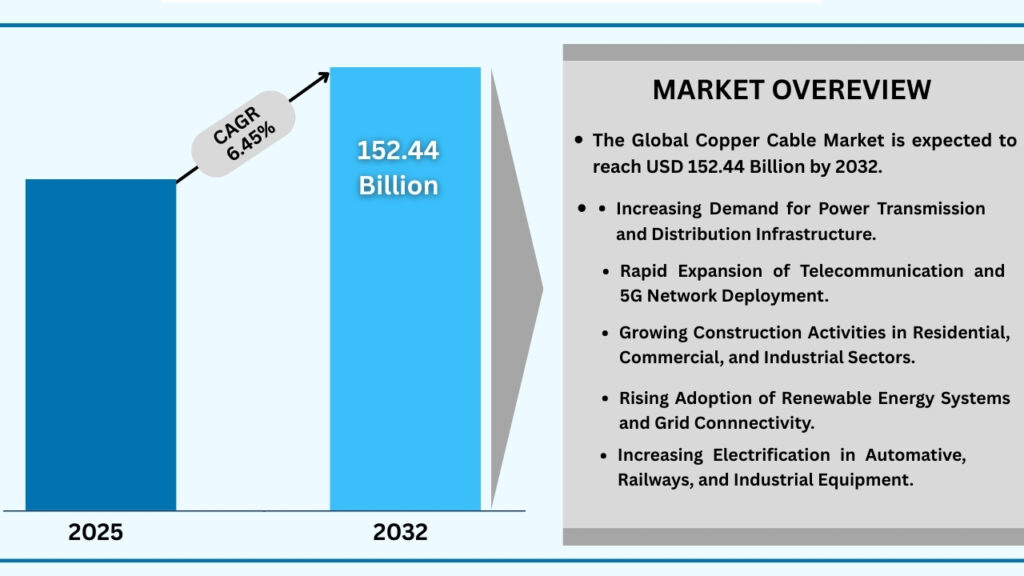
The global copper cable industry plays a critical role in supporting modern infrastructure, enabling efficient energy distribution, telecommunications connectivity, and industrial automation.
Rapid urbanization, digital transformation, and the expansion of electricity access in developing economies are major drivers for copper cable demand worldwide.
At the same time, manufacturers are facing rising production costs due to fluctuations in copper prices and increased demand for raw materials across multiple industries including electronics, automotive, and renewable energy.
Industry Scope Explained
The copper cable industry is a vast ecosystem consisting of raw material suppliers, cable manufacturers, electrical component producers, telecommunications infrastructure developers, and construction companies.
Key segments of the industry include:
• Power cables for electricity transmission and distribution
• Communication cables for telecommunications networks
• Industrial cables for manufacturing and automation systems
• Building wires for residential and commercial construction
• Automotive cables for vehicle electrical systems
• Renewable energy cables for solar and wind power installations
These cables serve as essential infrastructure components supporting global energy systems, digital networks, and industrial operations.
Copper Cable Manufacturing Segment
Manufacturers across the world produce a wide range of copper cables designed for power distribution, telecommunications, industrial machinery, and consumer electronics.
The manufacturing process involves copper rod processing, wire drawing, insulation application, and cable assembly to produce high-performance cables capable of handling varying voltage and environmental conditions.
Major product categories include:
• Low-voltage copper cables
• Medium-voltage power cables
• High-voltage transmission cables
• Communication and data cables
• Coaxial cables
• Instrumentation and control cables
However, fluctuations in copper prices and raw material supply disruptions can significantly impact production costs and profit margins for manufacturers.
Technology and Innovation in Copper Cables
The copper cable industry continues to innovate in order to improve energy efficiency, safety standards, and transmission performance.
Key technological advancements include:
• Fire-resistant and flame-retardant cable insulation
• High-efficiency power transmission cables
• Smart grid compatible cables
• Lightweight automotive wiring systems
• High-performance cables for data centers
• Advanced shielding technologies for electromagnetic protection
These innovations are enabling copper cables to meet the increasing technical requirements of modern energy grids, telecommunications networks, and industrial systems.
Services and Infrastructure Support
Beyond cable manufacturing, a significant portion of the copper cable market involves services such as installation, maintenance, and infrastructure development.
Key services include:
• Power grid installation and upgrades
• Telecommunications network deployment
• Industrial electrical system integration
• Infrastructure modernization projects
• Data center wiring and connectivity solutions
Growing investments in smart infrastructure and digital connectivity are increasing the demand for professional cable installation and maintenance services.
Key Risk Factors in the Copper Cable Market
Raw Material Price Volatility
Copper is a globally traded commodity, and its price is highly sensitive to supply-demand dynamics, mining production levels, and macroeconomic conditions. Sudden increases in copper prices can significantly raise manufacturing costs for cable producers, forcing companies to adjust pricing strategies or absorb higher production expenses.
To manage these risks, manufacturers are adopting strategies such as long-term supply contracts, recycling initiatives, and improved material efficiency in cable production.
Supply Chain Disruptions
Copper mining and refining operations are concentrated in specific regions such as South America, Africa, and Asia. Political instability, labor strikes, transportation bottlenecks, or environmental regulations in these regions can disrupt copper supply and affect global cable production.
Manufacturers are increasingly diversifying sourcing strategies and investing in regional supply networks to maintain stable raw material availability.
Competition from Alternative Materials
Although copper cables remain widely used for electrical applications, alternative materials such as aluminum conductors and fiber optic cables are gaining market share in certain applications.
Fiber optics, in particular, are increasingly used for high-speed data transmission in telecommunications networks due to their ability to carry large amounts of data over long distances with minimal signal loss.
This shift is prompting copper cable manufacturers to focus on specialized applications where copper maintains a performance advantage.
Energy and Production Costs
Cable manufacturing is an energy-intensive process involving copper processing, insulation production, and large-scale industrial operations. Rising electricity prices, regulatory compliance costs, and environmental sustainability requirements can increase operational expenses for cable manufacturers.
To mitigate these challenges, companies are investing in energy-efficient production technologies and sustainable manufacturing practices.
Regional Dynamics in the Global Market
Asia-Pacific
Asia-Pacific represents the largest and fastest-growing market for copper cables due to rapid urbanization, large-scale infrastructure development, and expanding electricity networks in countries such as China, India, and Southeast Asian economies.
Investments in renewable energy, telecommunications networks, and smart cities are driving significant demand for copper wiring and power cables in the region.
North America
The North American market is driven by investments in power grid modernization, electric vehicle infrastructure, renewable energy installations, and data center expansion.
Governments and utility providers are focusing on upgrading aging electrical infrastructure, which is increasing demand for advanced copper cable systems.
Europe
European countries are investing heavily in renewable energy integration, smart grids, and electric vehicle charging infrastructure. These initiatives require reliable power transmission networks, creating sustained demand for copper cables across the region.
At the same time, environmental regulations and energy transition policies are influencing manufacturing strategies within the European cable industry.
Competitive Environment and Key Participants
The global copper cable market is highly competitive, with several multinational manufacturers dominating production and distribution.
Key market participants include:
• Prysmian Group
• Nexans
• Sumitomo Electric Industries
• LS Cable & System
• Southwire Company
• Furukawa Electric
• General Cable
These companies compete based on product quality, technological innovation, global supply capabilities, and large-scale infrastructure partnerships.
Future Market Direction
The future of the copper cable market will be shaped by growing electricity demand, renewable energy integration, and digital infrastructure expansion.
Key trends expected to influence the market include:
• Expansion of smart grid infrastructure
• Growth in electric vehicle charging networks
• Increasing renewable energy installations
• Rising demand from data centers and telecommunications networks
• Advancements in high-efficiency power transmission cables
Manufacturers are also focusing on sustainable copper sourcing, recycling technologies, and advanced cable designs to meet evolving environmental and performance standards.
Conclusion
The Global Copper Cable Market remains a critical component of global infrastructure, enabling efficient power distribution and digital connectivity across industries.
While rising demand from electrification, telecommunications, and renewable energy projects creates strong growth opportunities, the market also faces challenges related to raw material price volatility, supply chain risks, and competition from alternative technologies.
Companies that invest in technological innovation, supply chain resilience, and sustainable manufacturing practices will be better positioned to succeed in the evolving global cable industry.
At Advantia Business Consulting, we help infrastructure developers, cable manufacturers, and energy sector stakeholders navigate the evolving dynamics of the global copper cable market. Through comprehensive market intelligence, strategic advisory, and industry trend analysis, we support organizations in identifying growth opportunities across power transmission, telecommunications, renewable energy, and digital infrastructure. With deep insights into supply chain risks, technology developments, and regional market dynamics, Advantia Business Consulting enables clients to make informed decisions and build resilient strategies in the rapidly expanding global cable industry.