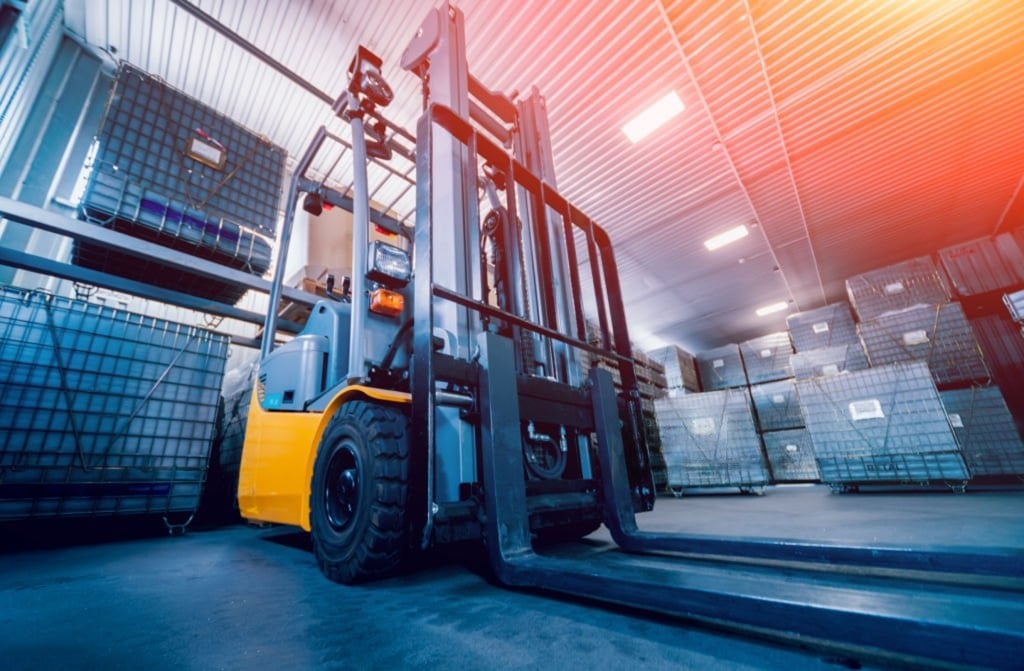
Market Pulse: Global Forklift Industry
The global forklift market is experiencing steady growth as material handling becomes increasingly vital across warehousing, manufacturing, construction, retail, and logistics sectors. The rapid expansion of e-commerce, rising industrial automation, and growing warehouse infrastructure are fuelling demand for efficient lifting and transport solutions worldwide.
Forklifts are evolving beyond conventional diesel-powered machines. Modern fleets now include electric, lithium-ion, and hydrogen fuel-cell forklifts equipped with telematics, automation, and safety-enhancing technologies. As supply chains become faster and more complex, businesses are investing in smarter and more energy-efficient material handling equipment.
Urban industrialization, large-scale logistics hubs, and the rise of organized retail are further strengthening forklift demand. Emerging economies are also modernizing industrial and warehousing infrastructure, significantly contributing to global market expansion.
Market Definition
The Global Forklift Market refers to the industry focused on the manufacturing, distribution, and deployment of powered industrial trucks used to lift, move, stack, and handle materials within short distances. Forklifts are essential for efficient material handling operations across industrial and commercial environments.
These machines include electric forklifts, internal combustion forklifts, reach trucks, pallet jacks, and automated forklifts. They are widely used in warehouses, ports, factories, construction sites, and distribution centers. Forklifts improve operational efficiency, reduce manual labor, and enhance workplace safety when handling heavy loads.
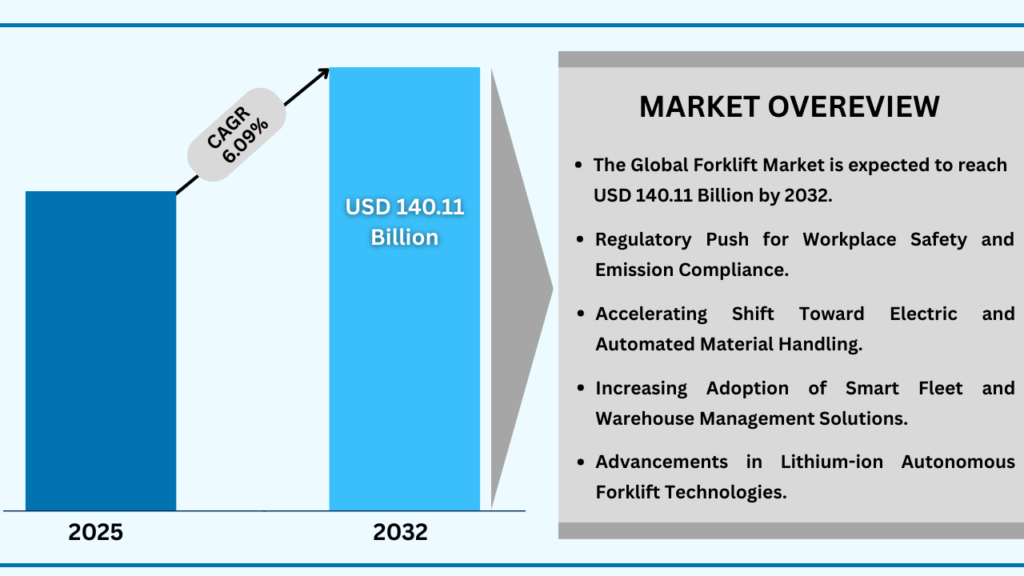
Industry Scope Explained
The forklift market includes equipment manufacturing, fleet management services, leasing, maintenance, and technology integration for material handling operations. It spans electric and fuel-powered forklifts, warehouse trucks, automated guided vehicles (AGVs), and related software solutions.
Forklifts are commonly used in industries such as logistics, food & beverage, retail, automotive, construction, and pharmaceuticals. The ecosystem involves OEMs, component suppliers, rental providers, software vendors, and after-sales service providers.
Forklifts operate across varied load capacities and lifting heights depending on application requirements. Reliability, maneuverability, and safety remain core performance criteria.
Key Advantages of Modern Forklift Systems
Versatile Utility Across Industries
Forklifts play a critical role across a broad spectrum of industries, including warehouse logistics, retail distribution, construction, manufacturing, ports, and wholesale trade, where efficient material movement is essential for daily operations. These machines are available in a variety of configurations—such as indoor electric forklifts for enclosed facilities, rugged outdoor models for construction sites, narrow-aisle trucks for high-density warehouses, and heavy-duty units for large or bulky loads—enabling businesses to choose equipment that precisely matches their operational needs. This application-specific flexibility allows companies to optimize material handling processes, accelerate loading and unloading activities, reduce manual labor, and make better use of available storage space. As a result, forklifts significantly enhance workflow efficiency, improve inventory handling speed, and support safer, more organized logistics environments.
Smart Fleet Management and Connectivity
Technological advancements are reshaping forklift operations by integrating telematics, IoT connectivity, and advanced fleet management software that bring greater intelligence and transparency to material handling activities. These technologies enable real-time monitoring of key parameters such as equipment utilization, battery health, maintenance schedules, location tracking, and even operator performance metrics. By turning operational data into actionable insights, businesses can proactively schedule maintenance, prevent unexpected breakdowns, and ensure equipment is used efficiently. Enhanced visibility also supports stronger safety compliance by identifying risky operating patterns and enforcing usage controls. Overall, connected forklift systems help organizations minimize downtime, extend equipment lifespan, improve workplace safety, and maximize fleet productivity across warehouse and industrial environments.
Productivity Enhancement and Cost Efficiency
Modern forklifts significantly boost productivity by enabling the faster, smoother, and safer movement of goods across warehouses, factories, and distribution centers. By reducing manual handling and speeding up loading, unloading, and stacking tasks, they help streamline material flow and shorten turnaround times. Electric forklifts, in particular, provide advantages such as lower operating and fuel costs, quieter operation suitable for indoor environments, and reduced emissions that support cleaner and more sustainable facilities. In addition, features like predictive maintenance alerts and energy-efficient system designs allow businesses to minimize unexpected breakdowns, optimize energy usage, and manage long-term operating expenses more effectively, ultimately ensuring better operational continuity and reliability.
Market Barriers and Industry Constraints
High Acquisition and Maintenance Costs
Forklifts involve significant upfront capital investment, particularly in the case of advanced electric, lithium-ion, or automated models that incorporate modern safety and connectivity features. Beyond the initial purchase, businesses must account for ongoing lifecycle expenses such as routine maintenance, battery charging infrastructure, battery replacement, spare parts, and periodic servicing to ensure reliable performance. These cumulative costs can be substantial over time, especially for fleets operating in demanding industrial environments. For small and medium-sized enterprises, such financial requirements may pose budgetary challenges, often delaying fleet modernization or limiting adoption of newer, more efficient technologies, even when long-term operational benefits are clear.
Operator Safety and Training Requirements
Improper forklift operation can significantly increase the risk of workplace accidents, including collisions, tip-overs, and load-handling incidents that may result in injuries, product damage, or operational disruptions. To mitigate these risks, companies must implement strict operator training programs and certification processes that ensure workers understand safe driving practices, load limits, and site-specific safety protocols. While these measures are essential for reducing liability and protecting employees, they also require ongoing investments of time and money for training sessions, evaluations, and refresher courses. As a result, maintaining safety compliance remains a top priority and continuous responsibility for employers aiming to create a secure and regulation-compliant work environment.
Regional Dynamics: North America and Asia Driving Demand
North America holds a strong position in the forklift market due to mature warehousing sectors, high e-commerce penetration, and widespread adoption of electric forklifts. The region also benefits from strict workplace safety regulations and advanced logistics networks.
Asia-Pacific is the fastest-growing region, driven by rapid industrialization, manufacturing growth, and expanding logistics sectors in China, India, and Southeast Asia. Large-scale warehouse development and export-oriented industries are major growth contributors.
Competitive Environment and Key Participants
The forklift market is competitive, with global manufacturers focusing on innovation, electrification, and automation. Key companies include:
• Toyota Material Handling
• KION Group (Linde, STILL)
• Jungheinrich AG
• Mitsubishi Logisnext
• Crown Equipment Corporation
• Hyster-Yale Materials Handling
• Doosan Industrial Vehicle
• Clark Material Handling
• Komatsu
• Anhui Heli Co., Ltd.
Companies are investing in lithium-ion batteries, automation, and operator-assist safety systems to strengthen market positioning. Fleet digitalization and sustainable designs are becoming major differentiators.
Investment and Partnership Trends
Forklift manufacturers and logistics providers are increasingly collaborating to deploy automated material handling systems and smart warehouse solutions that improve efficiency, accuracy, and throughput in modern supply chains. These partnerships are driving higher investments in robotics-integrated forklifts, advanced lithium-ion battery systems that offer faster charging and longer lifespans, and fleet analytics platforms that convert operational data into actionable insights for better decision-making. At the same time, rental and leasing models are becoming more popular as they give businesses the flexibility to scale fleets based on demand while avoiding large upfront capital expenditures. This shift toward service-based models enables companies to access the latest technologies, maintain cash flow stability, and adapt quickly to changing logistics requirements.
Future Market Direction
The forklift market is moving toward electrification, automation, and digital integration. Autonomous forklifts and AGVs are expected to gain traction in large warehouses and manufacturing facilities seeking labor efficiency and precision handling.
Sustainability will remain a priority, with increasing adoption of electric forklifts, hydrogen fuel cells, and recyclable battery technologies. AI-driven fleet optimization and predictive maintenance will further enhance operational efficiency.
Conclusion
The global forklift market is evolving into a technology-driven material handling ecosystem that supports modern supply chains and industrial operations. As warehousing and logistics activities expand worldwide, the need for efficient lifting and transport equipment continues to grow.
Companies that invest in automation, safety, and sustainable energy solutions will gain a competitive edge. Balancing performance, cost efficiency, and environmental responsibility will be key to capturing long-term growth opportunities in the global forklift market.
At Advantia Business Consulting, we help organizations navigate evolving industrial markets like the global forklift sector with confidence. By combining deep market intelligence, data-driven insights, and strategic advisory expertise, we support manufacturers, suppliers, and investors in identifying growth opportunities, understanding competitive dynamics, and making informed decisions in an increasingly automated and sustainability-focused material handling landscape.