Back to Mobility
Global Occupant Classification System (OCS) Market
Published Date : December 12, 2025 Category: Mobility
Published Date : December 12, 2025 Category: Mobility
The Global Occupant Classification System (OCS) Market is experiencing rapid transformation as global automakers intensify their focus on vehicle safety, regulatory compliance, and advanced automotive electronics. With rising emphasis on crash protection, intelligent airbag deployment, and enhanced passenger monitoring, OCS solutions have become a critical component of next-generation vehicle safety architectures. These systems—which detect, classify, and analyze the presence, weight, and position of occupants—are increasingly integrated into ADAS platforms, smart interiors, and connected vehicle ecosystems.
Growing concerns around road fatalities, stringent safety legislation across the U.S., Europe, China, and emerging markets, and the rising penetration of electric & autonomous vehicles are accelerating adoption. Automakers are shifting toward sensor-rich cabins capable of real-time decision-making, automated restraint control, and predictive safety analytics, making OCS indispensable across all major vehicle categories.
Market Overview
The Occupant Classification System market is expanding steadily as OEMs upgrade from basic seat-weight sensors to high-precision, AI-driven occupant detection modules. These systems support dynamic airbag control, child-seat recognition, seatbelt compliance, and safety automation.
Advancements in in-cabin sensing, machine vision, mmWave radar, and sensor fusion are enabling more accurate occupant profiling and compliance with evolving safety regulations such as FMVSS, Euro NCAP, and China NCAP. Additionally, the shift toward software-defined vehicles and the growth of electric & autonomous mobility are driving demand for intelligent cabin monitoring solutions.
Fleet operators, mobility service providers, and commercial vehicle manufacturers are increasingly integrating OCS for driver safety, passenger monitoring, and regulatory adherence—expanding the market beyond traditional passenger vehicles.
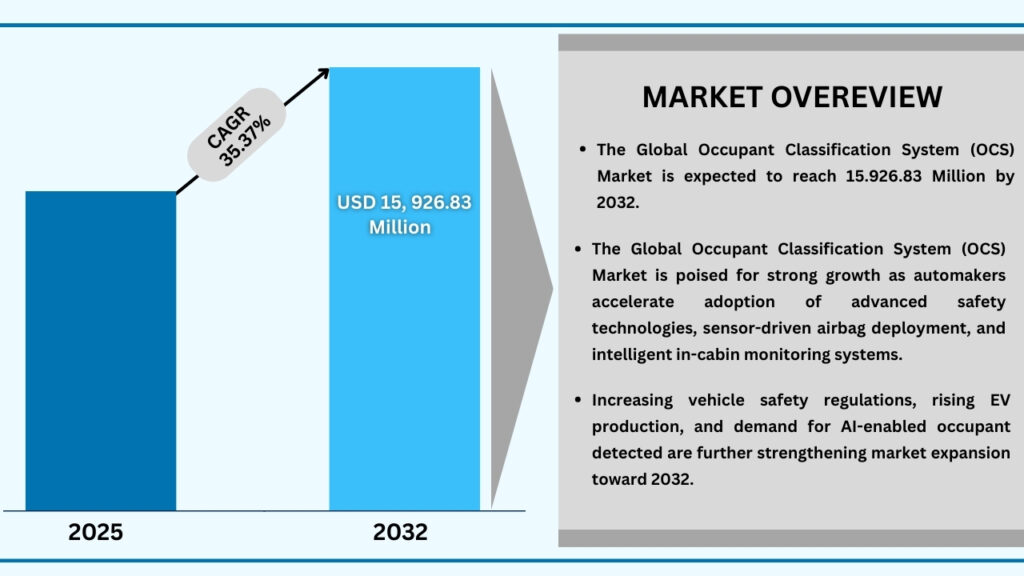
Global Occupant Classification System (OCS) Market – Overview
Market Definition
The Occupant Classification System (OCS) Market includes the technologies, sensor platforms, software algorithms, and electronic control units that detect and categorize vehicle occupants to optimize safety functions. These systems encompass:
• Weight, pressure, radar, infrared, and capacitive sensors for occupant detection
• Seat-integrated and overhead sensor modules
• Smart airbag control units (ECUs) for adaptive deployment
• Vision-based and multi-sensor fusion algorithms
• AI-driven in-cabin analytics for posture, presence, and behavior recognition
OCS solutions ensure that restraint systems operate efficiently while complying with global safety standards across passenger, commercial, and electric vehicles.
Technological Advancements & Evolution of Smart Cabin Safety
Breakthroughs in sensor intelligence, edge AI, and embedded vision are reshaping the OCS landscape. The shift from standalone sensors to multi-modal, algorithm-driven systems is improving accuracy and enabling predictive safety. Key advancement areas include:
• AI-powered occupant classification for posture, activity, and child detection
• mmWave radar and infrared sensing to overcome lighting and obstruction challenges
• Vision-based OCS integrated with driver monitoring systems (DMS)
• Sensor fusion platforms combining radar, cameras, and pressure sensors
• Lightweight ECUs supporting cross-domain vehicle architectures
• Software-defined safety features that update OTA (over-the-air)
These innovations support high-precision classification, dynamic airbag decisions, and integration with future autonomous and semi-autonomous vehicle cabins.
Market Limitations, Challenges & Barriers
Despite strong growth, the OCS market faces several operational and structural challenges:
• High integration and calibration costs increase vehicle production expenses
• Technical complexities related to sensor accuracy and environmental interference
• Sensor-software interoperability challenges across diverse vehicle platforms
• Evolving global safety standards requiring continuous upgrades
• Complexity in detecting non-traditional seating postures in autonomous cabins
• Reliability requirements that demand zero-failure performance
These constraints require significant R&D investment and close collaboration between OEMs, Tier-1 suppliers, and sensor manufacturers.
Policy Landscape, Safety Regulations & Industry Shifts
Government regulations and automotive safety ratings are playing a major role in accelerating OCS adoption. Updated mandates from NHTSA (US), Euro NCAP, and China NCAP now emphasize child detection, advanced airbag compliance, and smart restraint systems.
Global policymakers are promoting in-cabin safety technologies as part of broader road safety initiatives. OEMs are responding by integrating next-generation OCS into platform architectures, expanding testing frameworks, and partnering with technology developers to enhance system validation and compliance.
Integration of AI, In-Cabin Monitoring & Autonomous Vehicle Interiors
AI is reshaping cabin sensing and OCS performance through:
• Real-time occupant posture analysis
• Predictive airbag deployment algorithms
• Enhanced classification of children and small occupants
• Intelligent seatbelt reminder systems
• Adaptive restraint systems based on behavior analytics
As vehicles transition toward L3–L5 autonomy, cabins become more flexible, making AI-powered multi-sensor OCS essential for monitoring unconventional seating positions and ensuring safety in self-driving environments.
Regional Market Landscape
Asia-Pacific
Asia-Pacific leads global adoption due to massive automotive production, rising EV penetration, and stringent safety mandates in China, Japan, South Korea, and India. Automakers in the region are integrating advanced OCS into mid-range and mass-market vehicles, supported by significant investments in ADAS and in-cabin sensing technologies.
Europe
Europe maintains strong leadership driven by Euro NCAP’s evolving safety criteria, rapid electrification, and emphasis on premium in-cabin technologies. Germany, France, and the UK are advancing adoption of radar-based and AI-driven OCS systems as part of broader vehicle safety modernization.
North America
North America remains a key market as U.S. regulations increasingly mandate advanced occupant detection for airbag compliance and child safety. Strong presence of Tier-1 suppliers, robust R&D, and rapid uptake of autonomous and connected vehicles support market expansion.
Competitive Landscape — Global OCS Market
The market includes automotive Tier-1 suppliers, sensor innovators, electronics manufacturers, and software providers. Companies compete based on accuracy, sensor intelligence, system reliability, integration costs, and regulatory compliance.
Key Players Include:
• Robert Bosch GmbH
• Denso Corporation
• Continental AG
• ZF Friedrichshafen AG
• Autoliv
• Aptiv PLC
• Joyson Safety Systems
• IEE Smart Sensing Solutions
Strategic Industry Movements
Advanced AI-Driven OCS Platforms (2025)
A leading automotive supplier launched a next-generation OCS platform featuring AI-based posture recognition and adaptive airbag control. The solution improves classification accuracy across diverse seating positions, supporting new EV and autonomous vehicle interiors.
Sensor Fusion Expansion for Smart Cabins (2025)
In 2025, a major technology provider partnered with multiple OEMs to develop radar-camera fusion modules integrating occupant detection, child presence monitoring, and in-cabin analytics. The collaboration enhanced cross-domain safety intelligence and enabled broader deployment across premium and mid-range vehicles.
Future Market Outlook & Emerging Directions
The future of the OCS market will be defined by:
• Sensor fusion (camera + radar + pressure sensors) as a standard
• Autonomous-ready cabin sensing for reclined and rotated seating layouts
• AI-enhanced predictive safety systems
• Integration with driver monitoring systems for unified cabin intelligence
• Lightweight ECUs enabling centralized computing architectures
• Expansion of child detection mandates across global markets
OCS will be central to ensuring occupant safety in electric, connected, and autonomous mobility ecosystems.
Conclusion
The Global Occupant Classification System (OCS) Market is entering a phase of accelerated growth driven by regulatory pressure, intelligent safety innovation, and the evolution of smart cabins. With AI, radar, vision technologies, and sensor fusion reshaping in-cabin safety, OCS is set to become a core component of all future vehicle architectures. As global automotive players invest in autonomous mobility, precision sensing, and next-generation safety features, the OCS market is poised for strong, sustained expansion over the coming decade.
At Advantia Business Consulting, we partner with OEMs, Tier-1 suppliers, and mobility innovators to translate occupant-classification advances into compliant, deployable safety systems. Our services—sensor-fusion validation, regulatory pathway planning, systems integration roadmaps, and commercialization strategy—help clients mitigate integration risk, accelerate time-to-market, and maximise safety ROI. Contact Advantia Business Consulting to discuss a tailored roadmap for bringing your next-generation OCS solution from prototype to production.